
ecoSMRT®
Boil-off is cargo value in vapour form
Every LNG carrier generates boil-off gas, and what happens to it affects cargo retained, power consumed, emissions and the value delivered at the end of the voyage. ecoSMRT® returns excess boil-off to the tanks as liquid using a highly efficient Single Mixed Refrigerant process, protecting cargo value while reducing the energy required to reliquefy it.
Download ecoSMRT® brochureLNG -162°C
Ethylene -104°C
Ethane -89°C
CO₂ -55°C
LPG -48°C
Ammonia -33°C
Every kilogramme of boil-off is cargo you may not discharge
Heat enters an LNG cargo throughout the voyage, continuously generating boil-off. Some can be used as fuel; the rest must be managed. Without sufficient reliquefaction, excess boil-off is cargo that cannot be returned to the tanks and delivered at destination.
For owners and charterers, the challenge is not simply controlling tank pressure. It is balancing cargo retention, fuel demand, power consumption and charter performance across the vessel’s full operating profile.
The cargo you retain is the cargo you can deliver.
Return the excess to the tank using less energy
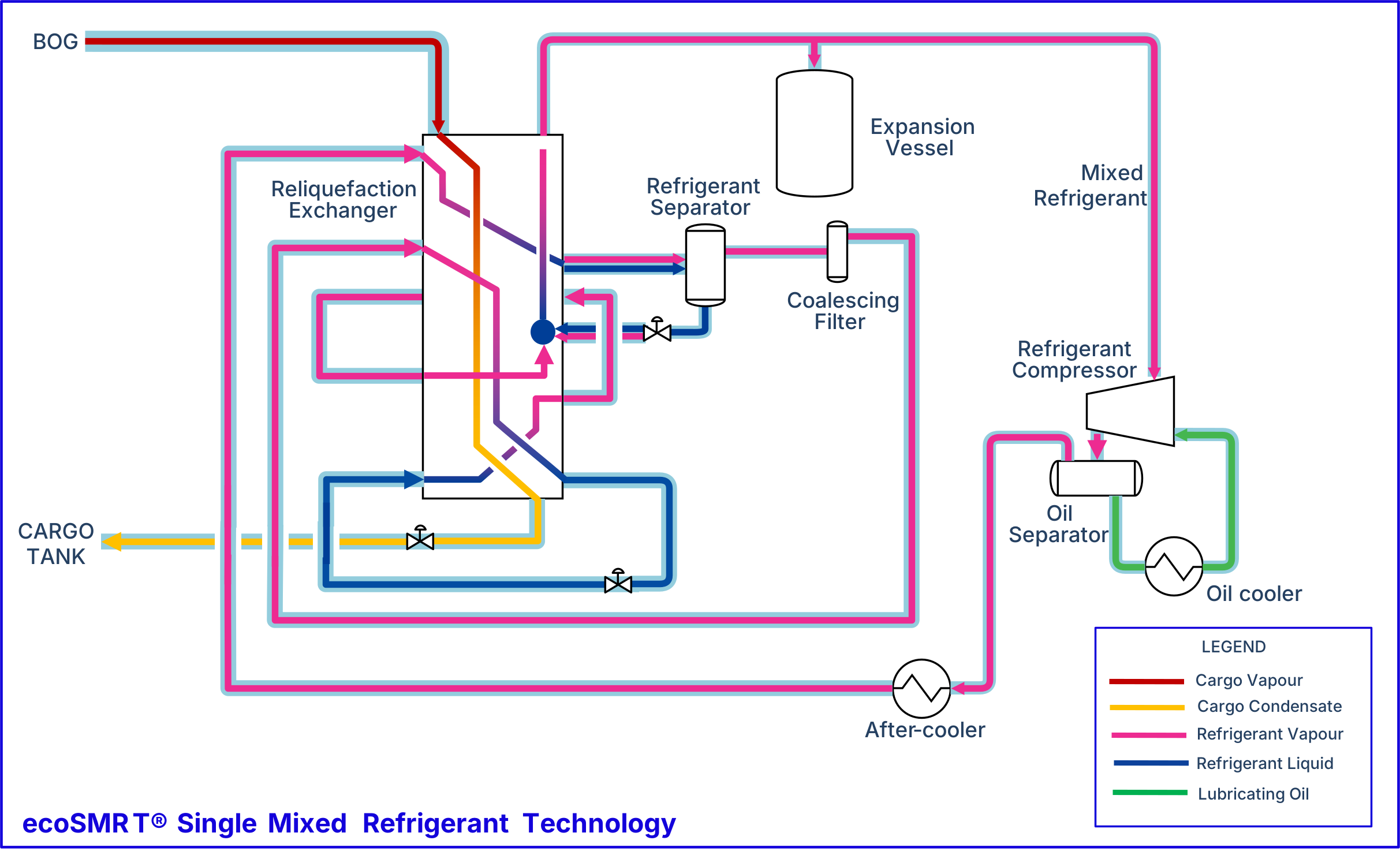
ecoSMRT® uses a single mixed refrigerant process to provide the refrigeration that condenses excess LNG boil-off. Boil-off is supplied to the reliquefaction exchanger, where cooling from the mixed-refrigerant circuit condenses the vapour before it returns to the cargo tanks as liquid.
The process uses a single refrigerant circuit; without the external pre-cooling some alternatives require. The result is a compact architecture needing only one refrigerant compressor.
Less machinery. Less power. More cargo returned to the tank.
More reliquefaction from every unit of power
ecoSMRT® specific power
0.74kWh/kg. Against representative competitor benchmarks of 0.94 to 1.04kWh/kg, ecoSMRT® needs materially less electrical energy for the same duty.
Guaranteed standard capacity
Guaranteed capacity of 1.9 tph, while capabile of delivering up to 2.1 tph.
Next generation capacity
Delivering up to 2.7tph, ecoSMRT® 2.5 extends the architecture to a guaranteed capacity of up to 2.5 tph NBOG.
Independent of ship speed
Reliquefaction capacity is available regardless of vessel speed, for flexibility across the trading profile.
A small difference in specific power becomes a large difference in operating cost
Reliquefaction runs for thousands of hours over the life of an LNG carrier. At that scale, the gap between ecoSMRT® 0.74 kWh/kg and competing levels compounds quickly. On a representative case* of 1.9 tph, 2,592 operating hours a year and power at $0.20/kWh:
vs 0.94 kWh/kg
$197k annual saving. A specific-power advantage of 0.20 kWh/kg
vs 0.97 kWh/kg
$227k annual saving. The mid-point benchmark
vs 1.04 kWh/kg
$295k annual saving. A specific-power advantage of 0.30 kWh/kg
Efficiency is not an abstract percentage. It is an operating cost for the life of the vessel.
Share your vessel operating profile and reliquefaction strategy and we will share your estimated savings.
Contact usDesign case*: The quoted figures use 0.20 USD/tonne based on auxiliary generators running on Marine Gas Oil (MGO) at 905 USD/tonne; Excludes LD compressor power for reliquefaction and excludes pump power for sub-coolers; Based on compressor and expander powers, excluding minor auxiliary equipment.
High performance without unnecessary complexity
One refrigerant compressor
A single refrigerant compressor, reducing rotating equipment against more complex arrangements.
Compact modular design
A skid-based architecture that simplifies integration and reduces installed footprint.
Lower maintenance demand
Fewer rotating components mean fewer maintenance interfaces and a reduced spares requirement.
Automated operation
Designed for automated operation and integration with the vessel’s wider control system.
Designed around the vessel, not one operating point
Newbuild
Integrated into the vessel and cargo-system architecture from the design stage.
Retrofit
A modular route to improving boil-off management and reliquefaction efficiency on suitable LNG carriers in service.
Multiple propulsion arrangements
Designed for integration across different LNG carrier propulsion and fuel-demand configurations.
Proven performance. Continuing progress
ecoSMRT® has continued to develop as fleet operating experience has grown. Guaranteed capacity rose from 1.5 to 1.7, then to 1.9 tph, with the latest improvement achieved without modifying existing installations. The next-generation ecoSMRT® 2.5 extends the architecture further (to 2.5tph) as LNG-carrier requirements evolve.
Built to perform today. Developed to do more tomorrow.
Proof
Proven at sea, not just on paper.
Read the case study.
>150 ecoSMRT® contracted
The 150th ecoSMRT® contract was secured in 2026
>1,000,000 operating hours
Fleet operational experience continues to inform system development
>100 vessels at sea
A substantial in-service fleet, across different vessels and trading profiles
>25 shipowners
Trusted by a broad international owner base
Through-life performance
Delivery is the start of the performance relationship
An LNG carrier may operate for twenty-five years, so reliquefaction performance matters long after gas trials. Babcock LGE supports ecoSMRT® through operational engineering support, remote monitoring and performance analysis, training, spares, upgrades and dry-dock support. The experience generated across the fleet feeds back into continued development.
LNG −162°C
Protect the cargo. Protect the charter. Protect the value.
The question is not simply how much boil-off a system can process. It is how much energy it uses to do it, how reliably it performs across the operating profile, and what that difference is worth across the life of the fleet.
Tell us the problem. We’ll bring the engineering.
Contact us