
Proving integrated ethane cargo and fuel handling at VLEC scale
Pacific INEOS Belstaff brought Babcock LGE’s ecoETHN® technology into operation onboard the world’s first Chinese-built 99,000 m³ VLEC, demonstrating how methane-rich boil-off gas could be managed as part of an integrated cargo and fuel system.
The project demonstrates how a difficult cargo component can become useful vessel energy, while cargo handling, fuel use and vessel control are engineered as connected parts of the same system
Pacific INEOS Belstaff represented an important step in the development of large-scale ethane transportation.
Built by Jiangnan Shipyard for Pacific Gas, the 99,000 m³ vessel was the world’s first Chinese-built Very Large Ethane Carrier of its size and the first VLEC of this capacity to use a Type B cargo-tank design. Primarily intended to transport US ethane to China and Europe, the vessel was also designed with the flexibility to carry ethylene and LPG.
For Babcock LGE, the project marked the first delivery of an integrated cargo-handling and ecoETHN® fuel-gas solution for this developing class of vessel.
The engineering challenge started with the cargo itself.
The challenge
Commercial ethane makes the cargo system work harder
Commercial ethane is not pure ethane.
Methane and other volatile components within the cargo become increasingly concentrated in the vapour phase as boil-off gas is generated. This more volatile fraction is harder to condense, increasing the duty placed on the reliquefaction plant and reducing its effective capacity.
For the vessel, the consequence is operational. More difficult cargo compositions can increase cargo-system operating time and energy demand while reducing available operating margin.
The challenge was therefore not simply to install sufficient reliquefaction capacity.
It was to determine how the methane-rich fraction of the boil-off gas should be managed without repeatedly asking the cargo plant to process the most difficult part of the vapour stream.
Our customer requirement
Jiangnan Shipyard contracted Babcock LGE to design and supply the cargo-handling systems for two new 99,000 m³ VLECs being constructed for Pacific Gas.
The vessels needed to safely manage commercial ethane cargo while controlling tank pressure and boil-off gas, providing the required reliquefaction performance and supporting the supply of suitably conditioned gas to the main engine and auxiliary generators.
The system also needed to integrate with the vessel’s wider automation and power-management arrangements, retain flexibility to carry ethylene and LPG, and provide reliable operation across long-distance trading routes.
For Pacific Gas, this meant creating a vessel capable of supporting the commercial requirements of INEOS’s international ethane supply chain while managing cargo and vessel energy efficiently.
What Babcock LGE delivered
Babcock LGE supplied an integrated cargo-handling and fuel-gas solution incorporating ecoETHN® and SuperCooler™ technology.
SuperCooler™ addresses the remaining cargo duty by increasing available reliquefaction capacity and improving plant efficiency.
ecoETHN® manages the methane-rich fraction of the boil-off gas by connecting the cargo-reliquefaction plant with the vessel’s fuel-gas system. Suitable methane-rich vapour can be directed towards the main engine rather than being continually recycled to the cargo tanks.
This reduces the difficult duty placed on the reliquefaction plant while making productive use of energy already available onboard.
Together, the technologies allow cargo management, boil-off gas, propulsion fuel and auxiliary power to be considered as connected parts of the vessel’s energy balance.
Remove the constraint. Use it as fuel. Release cargo-system capacity.
Integrating cargo, fuel and vessel control
Delivering that arrangement required close coordination between the Babcock LGE cargo and fuel-gas systems and the vessel’s propulsion, automation and power-management systems.
Pacific INEOS Belstaff was equipped with a dual-fuel main engine and shaft generator capable of using ethane as fuel. Høglund Marine Solutions supplied the integrated automation and ship-performance monitoring systems supporting the cargo and fuel-gas packages.
Effective interface design and integration logic were therefore fundamental to operating the complete arrangement safely and reliably.
For Jiangnan, the result was an integrated cargo and fuel-gas solution rather than a collection of independently engineered packages.
For the operator, it created an arrangement designed around how cargo, boil-off gas and vessel fuel would actually interact during service.
From first delivery to operational proof
Pacific INEOS Belstaff was delivered in 2021 and successfully completed its maiden voyage, entering service transporting ethane from the United States as part of INEOS’s international shipping operation.
The project demonstrated that Babcock LGE’s first ecoETHN®-equipped cargo and fuel-gas system could be integrated, commissioned and operated onboard a new generation of VLEC.
The strongest evidence came from the shipowner itself.
Following the vessel’s initial cargo operations, Pacific Gas reported that the integrated cargo-handling and fuel-gas arrangement had delivered improved efficiency and lower consumption, while contributing to lower CO₂ emissions.
That operational evidence was important because the proposition depended on the systems working together onboard, not simply on individual equipment achieving its design duty.
Pacific INEOS Belstaff demonstrated that the difficult characteristics of commercial ethane do not have to be treated solely as a cargo-system burden.
For Jiangnan Shipyard, the project provided the specialised cargo engineering and integration required for its first VLEC programme.
For Pacific Gas, it delivered a larger, flexible ethane carrier supported by an integrated cargo and fuel-gas system and a continuing through-life engineering relationship.
At system level, methane-rich boil-off that would otherwise increase reliquefaction duty could instead become useful vessel energy.
A difficult cargo component became useful vessel energy. A first 99,000m3 VLEC programme became a platform for the next generation of ethane carriers.
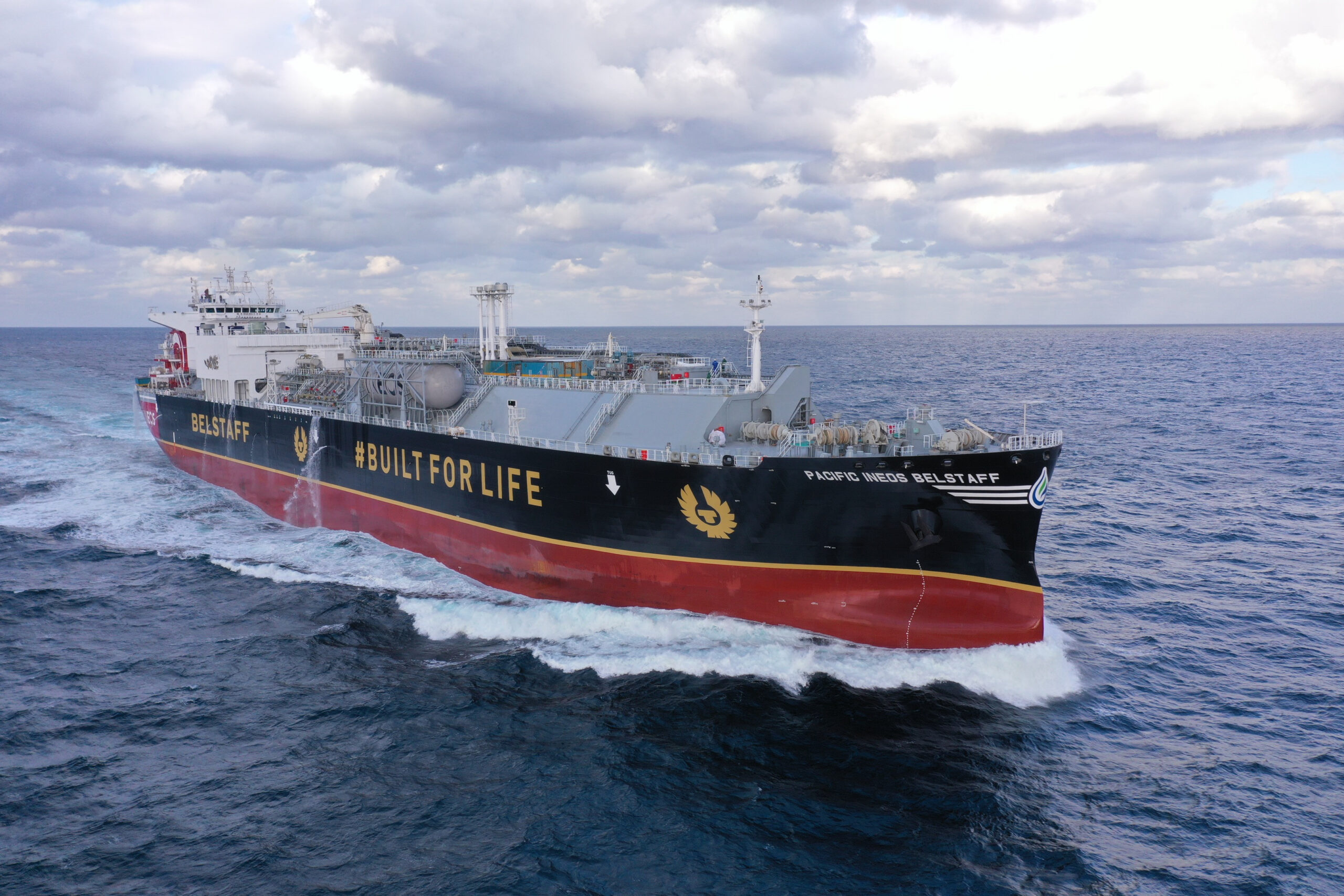
The project also extended an existing relationship between Pacific Gas and Babcock LGE.
Pacific Gas had previously worked with LGE on an 84,000 m³ LPG carrier constructed at a Korean shipyard before selecting Babcock LGE for the landmark Jiangnan VLEC programme. The owner subsequently highlighted the importance of Babcock LGE’s post-delivery service and troubleshooting support.
The engineering platform has since progressed further.
In December 2024, Babcock LGE announced a further contract for cargo-handling and fuel-gas systems for six 150,000 m³ Ultra Large Ethane Carriers at Jiangnan. Those vessels again combine SuperCooler™ and ecoETHN® technology and use methane-rich boil-off gas to support the main engine and auxiliary generators.
